Janakpur: After the government officially declared Madhesh Province as a drought affected area, international organizations under the coordination of the Association of International NGOs (AIN) have started expanding their activities throughout the region.
Responding to a request from the Chief Minister of Madhesh Province to provide immediate access to drinking water and irrigation, several international agencies have begun working on the ground. Their efforts include emergency support, water supply, irrigation services, and ongoing coordination with local bodies. The Social Welfare Council has also appealed to national and international organizations to support the response to the drought crisis.
According to Pramila Adhikari, AIN’s focal person for Madhesh Province, international agencies are operating in close coordination with the WASH cluster, District Disaster Management Committees, and local governments. These operations are being carried out through local partner organizations.
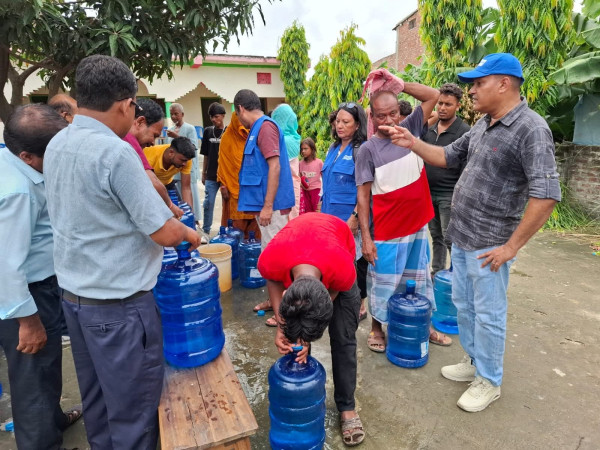
Save the Children Nepal has distributed 10,000 liters of drinking water to 534 households in Ward 10 of Ishwarpur Municipality in Sarlahi. Oxfam has provided clean water and shallow wells to 200 households in Chapur of Rautahat, and another 200 households in Haripur, Hariban, and Malangwa in Sarlahi.
Plan International Nepal has supplied water jars to 1,000 households in Sabaila Municipality of Dhanusha. Similarly, World Vision International Nepal has supported small irrigation systems for 55 households in Ekdara and 314 households in Samsi of Mahottari, as well as 93 households in Haripurwa of Sarlahi and 42 in Madhav Narayan of Rautahat.
Islamic Relief has begun deep boring work to supply water to 1,000 households in Rajpur and Chapur of Rautahat, and 50 households in Mahagadhimai and Suwarna of Bara. WaterAid has distributed handpumps and pipes for 300 Dalit households in Lahan Municipality of Siraha to improve access to drinking water.
SNV is supporting research and assessments regarding water availability in the province. It has also initiated studies on deep boring in five municipalities across Dhanusha and Mahottari.
Other international organizations such as People in Need, ActionAid, Good Neighbors, and UMN are currently working on project selection and coordination with local governments.
In addition, under the coordination of the National Disaster Risk Reduction and Management Authority and with funding support from the UK Government, the Start Fund Nepal project has been launched. The program is being implemented in ten municipalities including Birgunj and Bahudarmai in Parsa, Simrongadh in Bara, Paroha in Rautahat, Kabilasi in Sarlahi, Laxmipatthar in Siraha, and Rupani, Tilathi Koiladi, and Hanumannagar in Saptari. The program will operate for a period of 60 days.
According to the authority, this project will benefit 8,355 households, reaching more than 44,000 people. A total budget of NPR 26,033,476 has been allocated for the initiative.
Meanwhile, the World Food Programme has started installing shallow tube wells, pump sets, and motor pipes in Madhav Narayan Municipality of Rautahat and in Hanumannagar and Tilathi Koiladi of Saptari.
International organizations continue to work closely with the provincial government, local levels, and district disaster management committees. These efforts aim to provide both immediate relief and long term solutions. However, a clear and well defined policy from the Madhesh provincial government is essential to ensure sustainable response in the future.