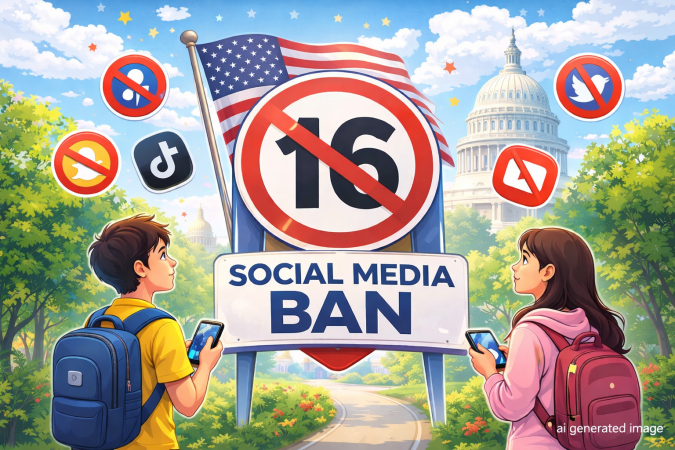
kathmandu: Australia has taken a decisive step into uncharted digital policy territory by banning children under the age of 16 from accessing major social media platforms, a move that is already influencing conversations in capitals around the world. The restriction, among the toughest of its kind, reflects growing concern that existing safeguards are failing to protect young users from the psychological and social harms linked to heavy social media use.
Under the new rule, responsibility shifts squarely onto technology companies rather than parents or schools. Platforms are required to take concrete measures to prevent under-16s from holding accounts, and failure to comply can result in substantial financial penalties. Australian officials argue that voluntary tools, parental controls, and self-declared age limits have proven inadequate in the face of sophisticated algorithms designed to maximize engagement.
The policy has been framed as a public-interest intervention, comparable to age limits on alcohol or driving. Government leaders say the aim is not to demonize technology but to give children more time to develop before being exposed to the pressures of constant comparison, algorithm-driven content, and online harassment. Advocates of the ban point to rising anxiety, sleep disruption, and attention-related problems among adolescents as warning signs that incremental reforms were no longer sufficient.
The decision has resonated well beyond Australia’s borders. Several governments in Europe, Asia, and Oceania are now openly discussing whether similar “hard” age restrictions should be adopted in their own jurisdictions. In some cases, lawmakers are reviewing whether existing frameworks based on parental consent should be replaced or strengthened with mandatory age verification systems. Australia’s approach is increasingly being cited as a test case for whether firm legal limits can succeed where softer rules have struggled.
At the same time, the ban has exposed difficult trade-offs. Age verification remains technically and ethically complex, raising questions about data privacy, accuracy, and unequal access. Critics warn that strict bans could push young users toward less regulated platforms or private messaging apps, potentially undermining the very protections the law seeks to provide. Technology companies have also cautioned that enforcing age limits at scale is far from straightforward and could create new risks if handled poorly.
Despite these concerns, the momentum behind stronger regulation appears to be building. For policymakers under pressure to respond to parental anxiety and mounting research on youth well-being, Australia’s move offers a clear, if controversial, model. Whether it becomes a global standard or a cautionary tale will depend on how effectively it is enforced—and whether it delivers measurable benefits for children without introducing new harms.
What is clear is that the debate over children and social media has entered a new phase. With Australia drawing a firm line at 16, governments worldwide are being forced to confront a fundamental question: should access to social media be treated as a regulated activity for minors, or remain a matter of individual and parental choice in a rapidly evolving digital world.