Hitkhabar, December 2025 | Artificial intelligence has quietly moved from a helpful tool to a constant presence in daily life. From work and education to communication and decision-making, AI systems increasingly mediate how people think and act. As usage intensifies, researchers are beginning to show that the psychological effects of heavy AI use are not sudden or dramatic, but gradual and deeply transformative.
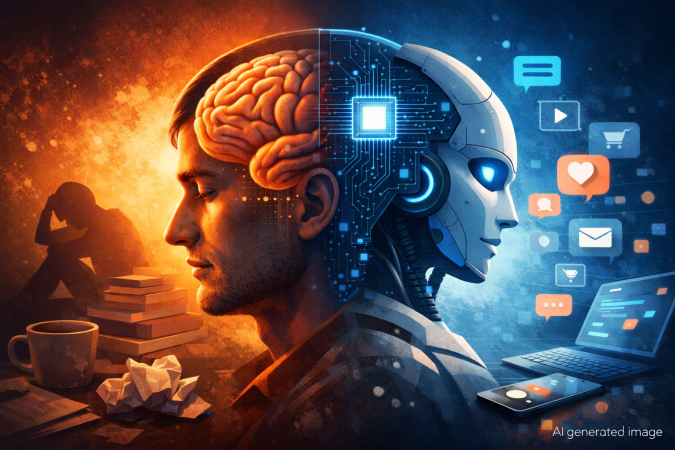
One of the most widely studied effects of prolonged AI use is cognitive offloading, the tendency to shift mental effort from the human mind to external systems. A 2025 study published in Societies found that frequent users of AI tools demonstrated weaker critical thinking performance when asked to complete tasks without assistance (Gerlich et al., 2025). The issue is not declining intelligence, but declining practice. When AI consistently provides answers, summaries, and solutions, the brain engages less in sustained reasoning and analytical depth.
Attention and focus are also being reshaped. Research examining generative AI use in learning environments found that users who relied heavily on AI struggled more with concentration and problem-solving once the tools were removed (Chen et al., 2025). Cognitive scientists describe this effect as attentional fragmentation, where constant exposure to fast, personalized responses conditions the brain to expect immediate feedback. As a result, slower activities such as deep reading, reflection, or complex reasoning feel disproportionately demanding.
Decision-making is another area where heavy AI use leaves a psychological mark. Recommendation algorithms increasingly influence everyday choices, from what people watch to how they work. Behavioral studies on AI-supported decision-making suggest that while AI reduces mental effort in the short term, prolonged reliance can weaken independent judgment and increase deference to automated suggestions (Verma, 2025). Over time, this may erode personal agency, as individuals grow less confident in decisions made without algorithmic guidance.
The emotional effects of AI use are now drawing serious attention. Observational research associated with the MIT Media Lab suggests that heavy users of conversational AI report higher levels of loneliness and emotional dependence compared to lighter users (MIT Media Lab, 2025). AI interactions offer immediate, non-judgmental responses, which can feel supportive. Psychologists caution, however, that substituting artificial interaction for human connection may reduce motivation to engage in real relationships, which are emotionally richer but require effort, vulnerability, and compromise.
Creativity is often cited as an area where AI empowers users, but research presents a more nuanced picture. Studies on AI-assisted writing and ideation indicate that while output increases, users may feel reduced ownership over their work (Springer Review, 2024). Over time, this can affect creative confidence. Constant exposure to fluent, confident AI-generated content also intensifies self-comparison, contributing to imposter syndrome and unrealistic expectations of productivity, particularly in professional environments.
Early neurological findings add further insight. Exploratory brain-imaging studies reported by European and U.S. research teams indicate reduced activation in brain regions associated with memory, planning, and attention when individuals rely heavily on generative AI during complex tasks (Le Monde / MIT, 2025). While these findings are preliminary, they suggest that the brain may adapt to external cognitive support by engaging less deeply in tasks it once handled internally.
Taken together, current research does not suggest that AI is inherently harmful to human psychology. Instead, it shows that uncritical and heavy reliance on AI can quietly reshape cognitive habits, emotional patterns, and self-perception. When AI is used as an assistive tool that supports human thinking, it enhances capability. When it replaces thinking, deciding, and relating, the psychological costs accumulate over time.
The real challenge of the AI era is not whether humans can adapt to intelligent machines, but whether they can do so without losing the depth, autonomy, and resilience that define human cognition.